SPC flooring sheet quality is influenced by more than the raw material formula. Even when a factory uses the same PVC resin, calcium carbonate, and additives, differences in feeding accuracy, temperature control, die design, roller alignment, and lamination can lead to different production results.
For flooring manufacturers, equipment precision matters because it helps keep the production process stable. Better control over each stage makes it easier to manage sheet thickness, width, surface appearance, and decorative film positioning. This article explains which equipment details have the greatest influence on SPC flooring sheet quality and what buyers should check when evaluating a production line.
What Does Equipment Precision Mean in SPC Flooring Production?
Equipment precision refers to how accurately a machine controls and maintains its operating conditions. In SPC sheet extrusion, this includes material feeding, screw rotation, processing temperature, melt distribution, roller positioning, and film alignment.
Precision does not mean that one component alone can guarantee a perfect sheet. The extrusion line works as a connected system. If the feeding section is stable but the die distributes material unevenly, the sheet may still have thickness variations. If the sheet is uniform but the calendering rollers are poorly aligned, the finished surface may show defects.
That is why buyers should evaluate the complete SPC and LVT flooring sheet extrusion equipment configuration instead of focusing on a single precision specification.
Feeding Precision Helps Maintain Material Consistency
The first stage to check is material feeding. SPC compounds contain several ingredients, and each component has a role in the final product. If the feeding quantity fluctuates, the composition entering the extruder may change during production.
Inconsistent feeding can make it difficult to maintain stable plasticization and melt flow. Operators may then need to adjust process settings more frequently, while the finished sheet may show changes in thickness or physical properties.
A precision-machined feeding screw can support more consistent material delivery. Buyers should ask about the feeding structure, adjustment range, metering method, and compatibility with the intended raw materials. It is also important to understand whether the supplier has experience with the buyer's formulation and filler ratio.
Temperature Control Affects Plasticization and Melt Stability
SPC compounds need to pass through different processing zones before reaching the die. Each zone has a temperature range that should be matched to the material and production conditions. If the temperature is too low, the compound may not plasticize sufficiently. If it is too high, the material may experience excessive heat exposure.
Uneven temperature distribution can also affect melt flow. This may create unstable extrusion conditions and make it harder to maintain consistent sheet quality.
When comparing equipment, check the number of heating zones, the temperature measurement method, control response, and insulation design. The equipment comparison identifies remote infrared heating as one of the configurations. Buyers should ask the manufacturer to explain how the heating system is controlled across the barrel and how temperature stability is verified during continuous production.
Die Precision Influences Sheet Thickness Across the Width
The extrusion die distributes molten material across the required sheet width. If the flow is not balanced, one area may receive more material than another. This can result in uneven thickness, edge instability, or differences in the sheet surface.
A coat-hanger die is commonly used in wide-sheet extrusion because its flow-channel design helps distribute melt across the die width. However, the die still needs to be designed for the specific material, width, thickness range, and output conditions.
Buyers should ask whether the die has adjustable lips, how the flow channel is processed, and what methods are used to check thickness uniformity. The supplier should also explain how die adjustments are carried out during commissioning and routine production.
Do not rely only on a statement that a die is precision-machined. Ask for relevant drawings, specifications, and test results where available.
Calender Roller Alignment Affects Surface and Thickness
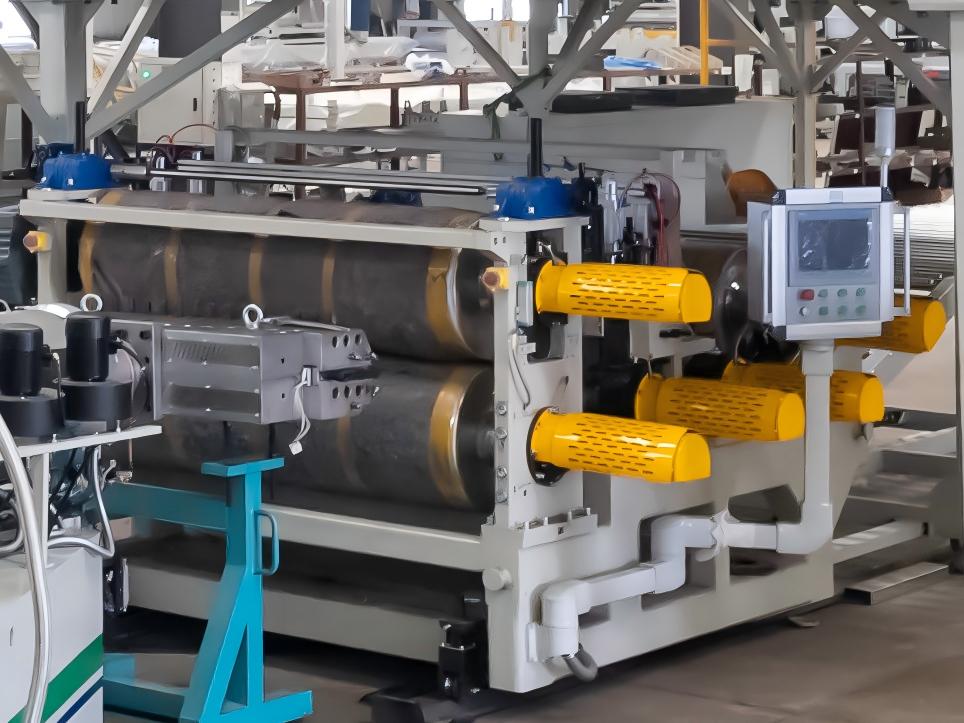
After extrusion, the hot sheet passes through the calendering section. The rollers help shape the sheet, control thickness, and establish the required surface condition. Roller alignment and surface quality are therefore important to the final product.
If the roller gap is inconsistent across the working width, the sheet may become thicker on one side and thinner on the other. Poor alignment can also contribute to uneven pressure, surface marks, or unstable sheet movement.
A five-roll calender configuration is included in the equipment comparison. Buyers should check the roller arrangement, machining accuracy, surface finish, adjustment method, frame rigidity, and temperature-control system. The calender should be matched to the target sheet width and thickness rather than selected by the number of rollers alone.
Preheating and Lamination Affect Decorative Film Bonding
SPC flooring products often use a decorative film and a transparent wear layer. During lamination, the film and sheet need to pass through a controlled heating and pressing process. If the temperature, tension, or pressure is not suitable, the finished surface may develop bubbles, wrinkles, weak bonding, or alignment problems.
Preheating rollers help prepare the sheet or film for the lamination process. The appropriate settings depend on the material structure and wear-layer thickness. Buyers should ask whether the preheating system can be adjusted for the products they plan to manufacture.
It is also important to check the film guiding system. A dual-camera visual alignment system with servo control can help monitor film positioning and support automatic correction. However, actual registration performance should be verified under the intended production conditions. Film quality, sheet stability, line speed, and operator settings can all influence the result.
Cooling and Line Speed Must Work Together
Once the sheet has been formed and laminated, the cooling section helps stabilize its dimensions before cutting. If cooling is insufficient or uneven, the sheet may continue to change shape after leaving the calendering section.
Line speed and cooling capacity need to be considered together. Increasing speed without matching the cooling system may affect dimensional stability. On the other hand, an unnecessarily slow line can reduce production efficiency.
Buyers should ask how the cooling system is configured, how water temperature and flow are managed, and whether the cooling length is suitable for the planned sheet thickness and production speed. A complete production test is more useful than comparing cooling equipment by length alone.
How to Check SPC Flooring Sheet Quality During a Machine Test
Before accepting a production line, buyers should prepare a practical test plan. The test should use the intended raw material formula and representative product dimensions. This makes it easier to identify whether the equipment can meet the actual manufacturing requirements.
- Measure sheet thickness at several positions across the width.
- Check whether the sheet width remains stable during continuous production.
- Inspect the surface for visible lines, marks, bubbles, or uneven areas.
- Check decorative film positioning and bonding after lamination.
- Observe whether material feeding and extrusion remain stable over time.
- Record the processing temperatures and line speed used during the test.
- Check whether cutting and stacking work smoothly with the upstream line.
The test results should be recorded together with the material formula, sheet dimensions, and operating settings. This gives both the buyer and supplier a clear reference for commissioning and future production.
For factories comparing different equipment types, the PVC and WPC flooring base material extrusion line is another equipment category worth reviewing when the planned product range includes more than SPC flooring sheets.
Why the Complete Equipment Configuration Matters
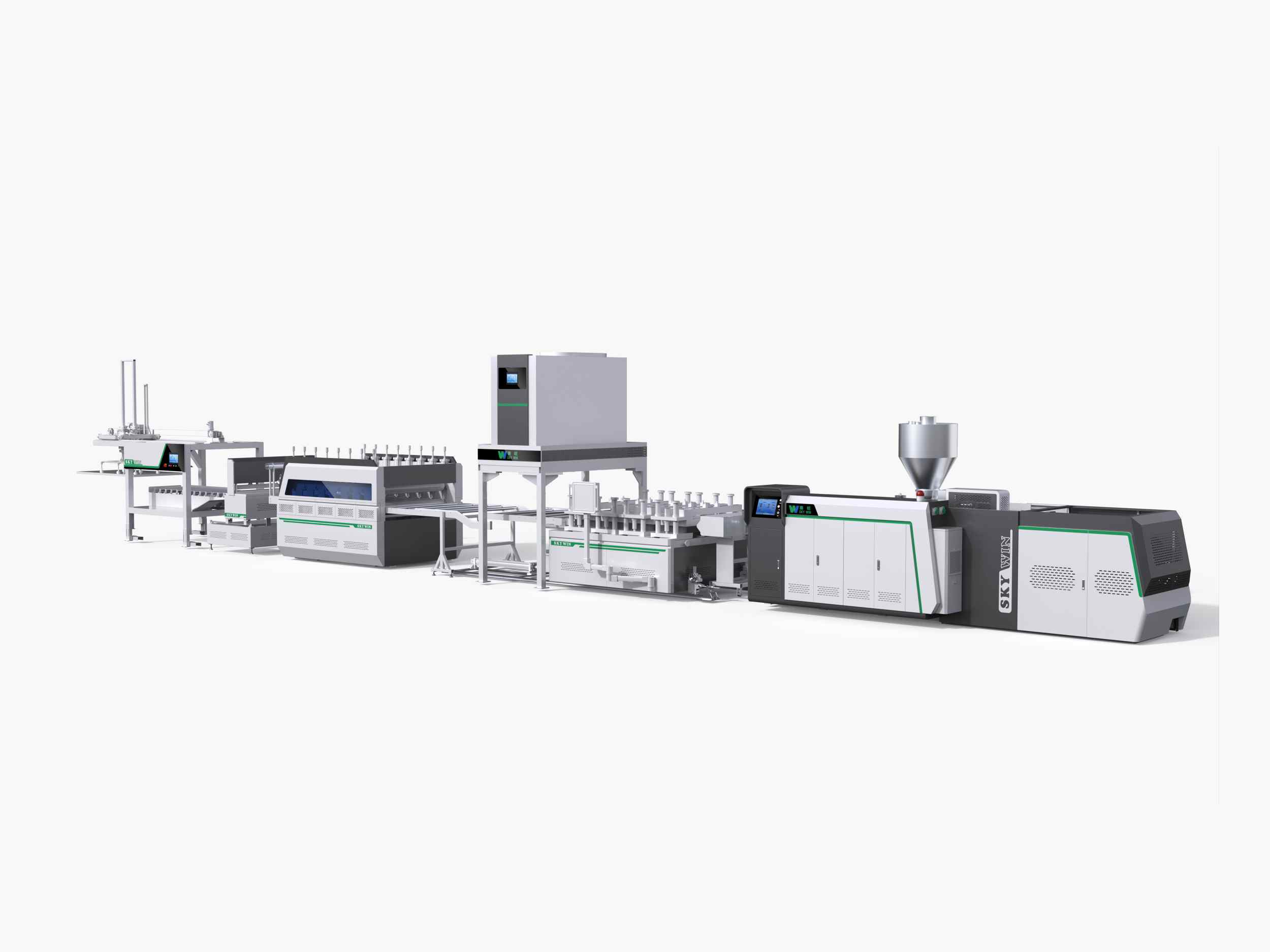
SPC flooring sheet quality is the result of several connected processes. Feeding precision supports material consistency, temperature control supports stable plasticization, the die distributes melt, and the calendering section controls sheet dimensions and surface condition. Lamination and cooling then influence the appearance and stability of the finished sheet.
For this reason, equipment buyers should compare the complete line and request a technical discussion based on their actual products. SKY WIN provides SPC and WPC flooring extrusion equipment, and buyers can review the available flooring extrusion machine range when planning a new production project.
Frequently Asked Questions
Which equipment factors have the greatest influence on SPC flooring sheet quality?
Feeding accuracy, temperature control, screw and die design, calender roller alignment, lamination settings, and cooling capacity all influence sheet quality. These factors should be evaluated as part of the complete production line.
Can precise feeding equipment eliminate SPC sheet thickness variation?
No. Precise feeding can help maintain a consistent material supply, but sheet thickness is also affected by melt distribution, die adjustment, calender roller alignment, line speed, and cooling conditions.
Why is a coat-hanger die used for SPC sheet extrusion?
A coat-hanger die is designed to distribute molten material across a wide die opening. Its flow-channel design can support more balanced melt distribution, but the die must still be matched to the material, sheet width, thickness, and production conditions.
What causes bubbles or wrinkles during SPC flooring lamination?
Possible causes include unsuitable preheating temperature, incorrect pressure, unstable film tension, surface contamination, or inconsistent sheet movement. The actual cause should be identified by checking the material and lamination settings together.
How can a buyer verify the precision of an SPC flooring extrusion line?
Request a production test using the intended formula and product dimensions. Measure sheet thickness and width at multiple positions, inspect surface quality, check film alignment, and record the machine settings during continuous operation.